
sharing is caring

🎧 Prefer listening to reading? Listen to the article here. ▶️


For many hotels, communicating their sustainability practices to their guests and other stakeholders is a major pain point. Why? Because of the fear of greenwashing, a term that arises again and again when it comes to communicating sustainability.

Greenwashing refers to the practice of making false or misleading claims about the environmental benefits of a product or service in order to appeal to environmentally-conscious consumers. It’s about misleading consumers into thinking that a product or service is more environmentally friendly than it actually is.

As the threat of greenwashing is real, we see that nowadays companies even opt to downplay or not communicate their sustainability efforts at all in order to avoid being perceived as greenwashers. There’s even a term for this: Greenhushing, the deliberate concealment of information regarding the sustainability practices applied.

By greenhushing = by underreporting the sustainability steps your hotel is taking, the result is that guests and your other important stakeholders miss the chance to be informed, educated and inspired. Of course, sustainability is not a sales strategy, it’s a business strategy that involves implementing sustainability holistically into all aspects of your hotel. Therefore, when it comes to communicating sustainability to your guests and others, the most important thing you should know is this: sustainability communication must follow action! That’s the ultimate key to avoiding the trap of greenwashing.

Untertitel
What to avoid, what to say instead, and how to prove it — plus a free template to write a hotel sustainability story guests trust.
Blog main image
Greenwashing im Hotel vermeiden: Entwickle deine Nachhaltigkeits-Story
Paragraphs

What is Sustainability Communication? What is Sustainable Communication?

Before we embark on crafting your sustainability story, it’s important we understand the role communication plays in sustainability. As independent and boutique hotel consultants that create sustainable hotels, we tell our clients to always communicate sustainability in a sustainable way. What does this mean exactly? Let’s look at the terms “sustainability communication” and “sustainable communication.”

Sustainability communication is the act of consciously integrating sustainability into a communication strategy by telling stakeholders about your sustainability goals and efforts. The objective of sustainability communication is to raise awareness and understanding about sustainability and what your hotel is doing on the front, and to encourage action to support your initiatives. Sustainability communication is the WHAT = your unique sustainability story, which we will craft together in three steps further below.

Sustainable communication, on the other hand, is about HOW you communicate vs. WHAT you communicate. This means you are communicating in a socially-responsible and ecological manner, with no negative impact to society, the economy and the Planet. The objective of sustainable communication is therefore to reduce the environmental and social footprint of communication activities and to make sure that all can profit from it.

In The Sustainable Hotel Handbook: Communication, we outline 10 Principles of Sustainable Communication to guide marketing and communication professionals in crafting their sustainability stories in the right way. They include the important elements: transparency, inclusiveness, cultural sensitivity, clarity, responsibility, authenticity, progress, relevance, inspirational, ethical. While in the handbook we guide you through these principles with practical examples and checklists, we have included an overview in the template below, which we encourage you to download.

By communicating sustainability in a sustainable way and having the right sustainability story in place for your hotel, you build awareness for your brand, create a positive image of your hotel in the heads of guests, engage and motivate your employees, and better comply with reporting rules and regulations. Of course, you also avoid greenwashing.

Now let’s begin by following our four-step approach:

Sustainability communication
must follow action!

1. WRITE your hotel sustainability story

A captivating central story is the cornerstone of your communication strategy. It should build off your Purpose and be informed by your priorities. A compelling and authentic sustainability story captures what’s unique about sustainability at your hotel and touches on your overall approach to tackling it. It takes a strong stand or point of view and reflects your hotel’s unique personality.

Our practical template for download below will guide you in writing your hotel sustainability story! And the best part about it? It’s free!

Free template

Write your hotel sustainability story in three simple steps

A guided three-step template for clear, specific wording with space to add your evidence. Includes the Ten Principles of Sustainable Communication.

2. TAILOR the story to your stakeholders

When it comes to communication, the most efficient approach is the integrated communication method. Integrated communication ensures that, regardless of the channel or audience, the message is consistent and cohesive. Otherwise, you risk creating confusion and misunderstanding, which can result in a loss of trust or perception of inauthenticity.

Your central message is thus the red thread that runs through all your sustainability communications, making it consistent and coherent to your audience groups: Guest, Employees, Partners, Local community, Media, etc.

When it comes to messaging, we follow the “Know, Feel, Do” model, which is a simple and effective way to ensure People read your message, and that you inspire the correct emotion and encourage a desired action.

  • KNOW: What do you want them to know about your sustainability strategy? How does it impact them?
  • FEEL: What do you want them to feel about it?
  • DO: What actions do you want them to take as a result?

As a next step, take your central story and address the “Know, Feel, Do” for each key stakeholder group listed above. 

3. CHECK that your storytelling is aligned with the 10 Principles of Sustainable Communication

Once you have defined WHAT you are communicating = your sustainability story, you also have to make sure that you are telling your story in a sustainable way. The HOW is equally important. You can use the overview of the 10 Principles of Sustainable Communication in our free template as a checklist to make sure that your storytelling is transparent, inclusive, culturally sensitive, clear, responsible, authentic, progressive, relevant, inspirational and ethical.

4. TEST your hotel sustainability story

When it comes to getting your sustainability story done and dusted, the last step is a pretty straightforward one: test, test and test! Check how your messaging resonates with your stakeholders, gather feedback and make any necessary revisions to ensure your communication makes the kind of impact you want. Once you’re happy with it, you can build out supporting messages that go into more detail e.g. concrete actions you’re taking, specific targets you want to reach, or what you have achieved so far.

Including specific goals, targets and data within this extended narrative will demonstrate your commitment to sustainability and make it easier for People to trust you.

Congratulations, you now have your hotel sustainability story in place!

This story will serve as the basis of all your communications around your sustainability initiatives, and will make sure that it is not only consistent across all your channels, but credible too. By demonstrating credibility, you ultimately avoid the trap of greenwashing and increase the impact your sustainability initiatives have.

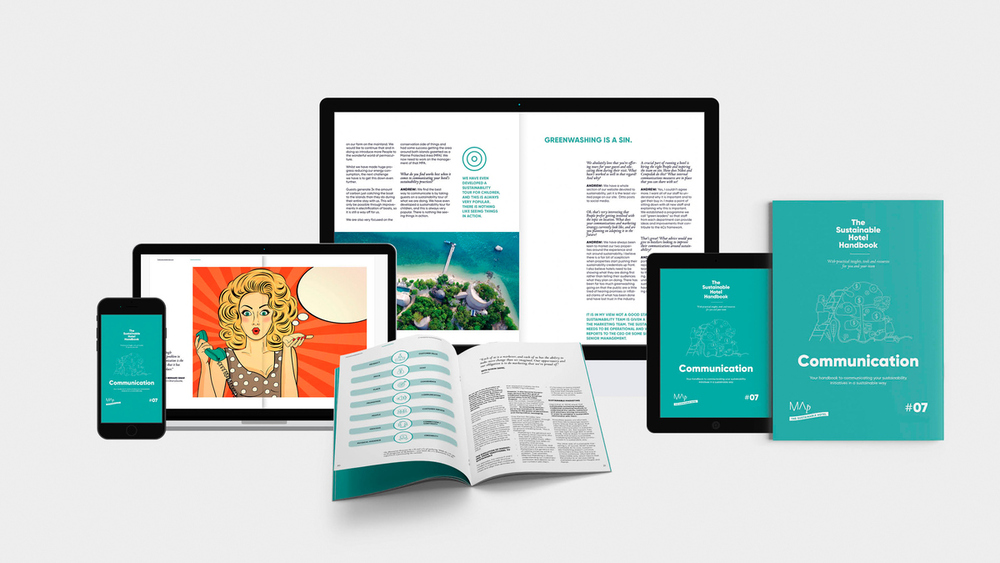
If you want to learn more about communicating sustainability in a sustainable way, check out The Sustainable Hotel Handbook: Communication, which we will be launching soon over on The Sustainable Hotel. In it, we guide you through not only building your sustainability story, but communicating it internally and externally, with insights into effective communications, practical tools such as exercises and checklists, as well as success stories and best practice examples. Check it out HERE.

Video URL
Blog Block Image
Avoid Greenwashing in Hotels: Craft Your Sustainability Story

Add new comment

Comment

Order

Plain text

  • No HTML tags allowed.
  • Lines and paragraphs break automatically.
  • Web page addresses and email addresses turn into links automatically.
Youtube stream image
Avoid Greenwashing in Hotels: Craft Your Sustainability Story
sharing is caring

We are delighted to host this MAp meets with our MAp Boutique Consultancy team member Lisa Flora. Lisa Flora has been part of the MAp team since April 2023 and successfully defended her Master's thesis (Sustainable Regional and Destination Development course) entitled "The design possibilities of rural space, in an urbanised world." at the end of 2023 #woohoo.

In the course of her thesis at the University of Innsbruck and UMIT Hall, Lisa Flora dealt intensively with the development opportunities of rural areas and researched the extent to which young people's lifestyles and current technological trends affect the relative competitive relationship between urban and rural areas in Germany.

Untertitel
MAp talks to our team member Lisa Flora about how rural communities can use technology to respond to the future aspirations of young people and thus become more attractive.
Blog main image
Technology as a driving force for positive rural community development MAp Boutique Consultancy MAp meets Lisa Flora Buchauer
Paragraphs

Dear Lisa Flora, once again a big CONGRATULATIONS on completing your Master's degree in Sustainable Regional and Destination Development! Can you give us a brief insight into how you methodically approached this major sustainability topic of "making rural areas more attractive for young people"?

Thank you very much and with pleasure! It was clear to me that the first thing I wanted to do was analyse statements from young people throughout Germany. That's why I carried out youth study analyses. The aim was to find out: what is particularly important to young people between the ages of 12 and 25 when planning their future? I then used the information gained from this to carry out a systematic literature analysis and focused on technological trends, rural areas and the wishes of young people. This is the short version, because a Master's thesis consists of many individual methodological steps that are probably not so exciting for our readers. But our MAp mantra also applies here: #StepByStep.

Now, of course, we are looking forward to the answer! What do young people in Germany want for their future? Or what do they expect?

Three aspects seem to be particularly important to young people in Germany when it comes to their future: Flexibility, social life and standard of living. All three aspects are related to both everyday private life and professional life. It can currently be observed that young people feel that they can mainly realise these ideas in a city or urban area. Unfortunately, young people are therefore considering rural communities less and less as a place to live.

An interim question Lisa Flora, why did you set your Master's thesis in Germany?

The topic affects many people, of course! But I find it particularly interesting in Germany because there have been active attempts since the 1990s to initiate a counter-movement to rural exodus. For example, attempts were made to create equal living conditions and opportunities for urban and rural areas with the so-called spatial planning programme. However, this has not been a great success. I found it exciting to find out how technology could be used to achieve these goals in the future.

However, the results can also be applied to comparable countries such as Austria.

Why was it important to you to research and better understand the dynamics of rural areas in an urbanised world? What significance does this topic have for society and, above all, for future developments?

In times when the focus is increasingly on urban centres, rural areas are increasingly being pushed into the background. We can see that this has led to a negative spiral in recent years: As population density decreases, the infrastructure network in rural areas tends to become "patchier". This in turn means that many rural communities are struggling with the decline in educational opportunities, catering facilities and the closure of doctors' offices and police stations. And this makes local people unhappy, which is why many see the solution as moving to the city.

For the future, I see it as crucial that this trend changes. Firstly, in terms of social cohesion, so that there is a balanced and fair society in which all citizens have access to the same resources, services and opportunities regardless of where they live. And secondly, to ensure a diverse economic structure and the preservation of cultural identities. But the list is long and varied!

Successful rural community development today is about using technology not just as infrastructure,
but as a catalyst for social interaction, education and professional opportunities
@Lisa Flora Buchauer via @weareMAp

To what extent do technological trends play a role in the development of rural communities?

In recent years, technological progress has had a major impact on our daily lives, whether in the countryside or in the city. We have integrated technology into our everyday lives to such an extent that it is hard to imagine life without the many opportunities it has created. Young people in particular are making completely new demands on their place of residence as a result.

However, as already mentioned, in many rural areas in Germany, the infrastructure - including the digital infrastructure - is not as good as in the city and it is therefore not possible to keep up with the urban offer.

In summary, this means that successful rural community development today consists of using technology not only as infrastructure, but also as a driver for social interaction, education and professional opportunities. By integrating technologies that reflect the individual wishes and dreams of future generations, rural communities can not only become more attractive, but also better tailored to the needs of the future.

Does the topic of sustainability also play a role in relation to your research results?

The topic of sustainability plays a crucial role in the context of rural areas and is of great importance for their long-term development. However, my research findings primarily emphasise the social aspect of sustainability. For young people, it seems to be particularly important for their personal future to live in a place that promotes social justice, strengthens the community and offers initiatives that improve quality of life. Always in the context of technological offerings and opportunities.

How can the findings of your master's thesis be put into practice? What are the top 5 concrete measures that can be taken to make rural areas more attractive to young people through technology?

What I like about my work is that I was able to identify concrete examples of implementation. Even simple measures can enhance rural areas for young people.

My top 5 recommendations for rural communities are:

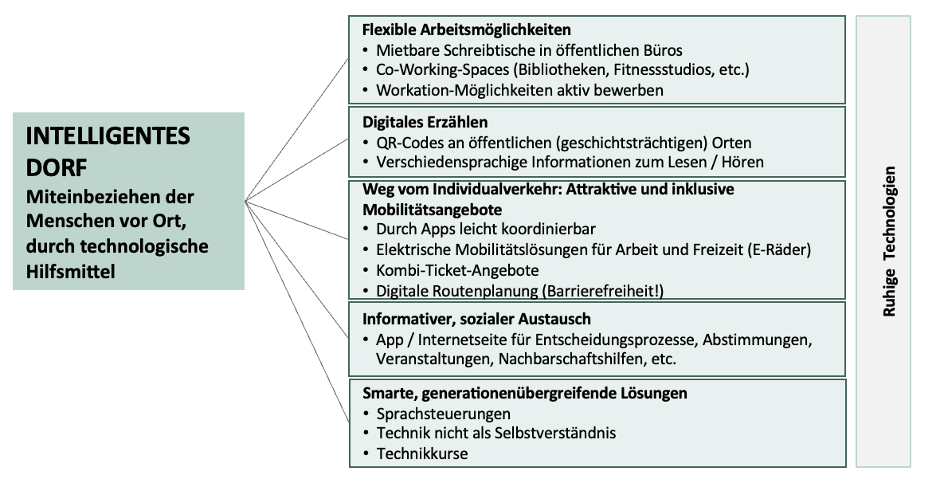
1. Promotion of social infrastructure through technology:

Introducing digital platforms for information, announcements, voting and coordination of community activities and neighborhood assistance.

2. Improving mobility through technology-based solutions:

Introduction of coordinated mobility offers that can be controlled via an app. Combined ticket offers in particular increase attractiveness (combining car-sharing, buses, e-bikes, etc.). When planning digital routes, always offer barrier-free routes (suitable for wheelchairs, etc.) for comprehensive accessibility for all.

3. Creation of flexible working options and co-working spaces:

Provide creative workspaces (co-working spaces) to appeal to people with (increasingly common) flexible working models. Actively promoting rural areas as attractive places for "workation" also attracts young people.

4. Digital storytelling in places steeped in history:

Integrating technology to make stories and information accessible at historically significant places. The playful exchange of information generates interest among many young people. Use of QR codes to provide background information and emphasise the history of a place/street. (For example: Why is Jägergasse called what it is and what used to stand on such and such a street corner?)

5. Cross-generational technology accessibility:

Young people want to feel they can be happy where they live, even as they age. Therefore, creating inclusive technology solutions that are accessible to all age groups; providing technology courses, especially for older people, to improve their technological literacy. Introducing technology gradually and in consultation with the community for seamless integration.

Technologie als Impulsgeber für attraktive Dorfentwicklung

Source: Lisa Flora Buchauer

Of course, our final MAp meets question should not be missing today: What makes a truly unique hotel experience for you personally?

For me personally, a truly unique hotel experience is above all a "certain gut feeling". If I have a positive feeling when I first enter the hotel, I know it's something special.

A unique hotel experience for me is therefore a place that creates an emotional connection. And for me, such an emotional connection is created, for example, by offering various local experiences or creatively displaying the hotel's history in corridors / on the website.

And I have to admit: I'm also happy about the classic little chocolate on the bed pillow - preferably locally produced ;-)

About Lisa Flora Buchauer:

Lisa Flora was born in Innsbruck. Through her Bachelor's degree in Sociology and Master's degree in Sustainable Regional and Destination Development, holistic sustainability has become a matter close to her heart. She now lives in Zurich and is not only an expert in sustainability, but also a passionate coffee enthusiast and cyclist. Connect with her on LinkedIn.

Blog Block Image
Technology as a driving force for positive rural community development MAp Boutique Consultancy MAp meets Lisa Flora Buchauer

Add new comment

Comment

Order

Plain text

  • No HTML tags allowed.
  • Lines and paragraphs break automatically.
  • Web page addresses and email addresses turn into links automatically.
Categories
Types
sharing is caring

We at MAp Boutique Consultancy believe brands themselves can be (and should be) sustainable. Over the last year, we’ve seen an increase in requests for creating sustainable hotel brands, which as a B Corp-certified agency, makes us very happy!

The fact is, consumers are no longer content with mere transactions; they seek stronger connections with brands that align with their values. As a result, brands are under increased scrutiny to not only provide high-quality products and services but also demonstrate their commitment to people and planet.

In this blog post, you’ll learn how to create a sustainable brand by:

  • Applying MAp’s 4 Ps of Sustainability
  • Developing well-designed visual identities
  • Auditing your supply chain
  • Choosing eco-friendly marketing materials
  • Following the principles of sustainable communication
Untertitel
Your blueprint for your brand's success
Blog main image
Schritt für Schritt zum nachhaltigen Branding
Paragraphs

What exactly is a sustainable brand?

Sustainable branding focuses on integrating sustainability into a brand's identity, values and practices. It goes beyond the superficial use of eco-friendly imagery or slogans and requires a deep commitment to environmental, social and economic responsibility. A sustainable brand has the power to influence change, drive consumer loyalty and inspire positive action.

Now that we've established the importance of sustainable branding, it's time to explore how to create a sustainable – and successful - brand.

Here's MAp’s step-by-step guide to help you get started:

1. Apply MAp’s proprietary framework on sustainability, aptly titled MAp’s 4 Ps of Sustainability: Purpose, People, Planet, Profit.

For every brand we create, we approach it holistically through the lens of the 4 Ps to determine how we can best portray a hotel’s Purpose, inspire and uplift its people, minimise its impact on the planet and economically benefit all of its stakeholders. When you enter into a (re-)branding process, we recommend to keep these 4 Ps close to you and ensure they are reflected in every aspect of your brand – from its visual identity to its verbal identity.

2. Develop well-designed visual identities that stand the test of time and are functionally adaptable.

Not only are branding or rebranding exercises a big commitment (financial and otherwise), they necessitate the production of new marketing materials and the elimination of old ones (= more waste).

When you practice sustainable branding, you overcome this by creating a visual identity that is timeless and therefore avoids becoming quickly outdated - instead, it grows with your business across existing and future product lines, projects, subsidiaries and more.

3. Audit your supply chain to source from sustainable suppliers, wherever possible.

Sourcing materials and services from responsible partners is essential – they should align with your sustainability values and meet your sustainability expectations. Beyond that, though, it’s important to give opportunities to small businesses, local ones, and those owned by women and people of colour when possible.

Also check if your partners have sustainability certifications in order to make sure that they walk the walk too!

Sustainable branding goes beyond the superficial use
of eco-friendly imagery or slogans and requires a deep commitment to environmental, social and economic responsibility.
@weareMAp

4. Choose eco-friendly marketing materials.

Today, there are many options for choosing environmentally-friendly materials and packaging, from biodegradable paper to eco-friendly printer ink. For your marketing material, we suggest to research and find the best partners and products to make your sustainable brand happen.

5. Follow the principles of sustainable communication and create an emotional connection with your audiences.

The brand verbal identity and messaging we develop follow MAp’s 10 Principles of Sustainable Communication: transparency, inclusiveness, cultural sensitivity, clarity, responsibility, authenticity, progress, relevance, inspirational, ethical.

We also recommend to employ emotional storytelling techniques to connect and appeal to audiences – not just your guests, but also your employees, partners and local community members. By following these steps, you can create a sustainable brand that not only resonates with your stakeholders but also empowers positive change in the world, making your brand a force for good.

The Sustainable Hotel Handbook: Communication

Master your brand's sustainability communication

Learn how to effectively communicate your sustainability activities with the help of MAp’s 10 Principles of Sustainable Communication and other practices to mitigate greenwashing and achieve more success.

Blog Block Image
A step-by-step guide to sustainable branding

Add new comment

Comment

Order

Plain text

  • No HTML tags allowed.
  • Lines and paragraphs break automatically.
  • Web page addresses and email addresses turn into links automatically.
Types
sharing is caring

Today we are very pleased to conduct this MAp meets with Luise Weinert, Bachelor student at the University of Applied Sciences Graubünden. Luise was our mentee for the last year and decided to dedicate her bachelor thesis to the topic of sustainability communication. In September 2023, she defended her thesis, receiving the highest number of points available.

As the client and co-advisor of this thesis, we are naturally very pleased about this. We would like to take this opportunity to thank Dr. rer. soc. Lena Pescia, lecturer in tourism management at the FHGR and advisor of the thesis, for the great cooperation. A big thank you also goes to Riccarda Ryffel, head of the FHGR mentoring programme, with whom we have been cooperating successfully for years.

Untertitel
MAp meets Luise Weinert, student at the University of Applied Sciences of the Grisons, to talk sustainability communication in the hotel industry.
Blog main image
This is how you communicate sustainability to your hotel guests.
Paragraphs

Dear Luise, congratulations on your excellent work and the successful completion of your studies. What sparked your interest in devoting your bachelor thesis to the topic of sustainability communication in the independent hotel industry?

Luise: Thank you very much! I really enjoy browsing hotel websites and researching information about potential travel accommodations. This passion started when I was working as a flight attendant, when I regularly stayed in hotels and developed a growing interest in the industry. During the mentoring programme, Magdalena then told me that hoteliers often don't know exactly how to communicate about sustainability. This realisation not only piqued my curiosity, but also strengthened my desire to learn more about the specific difficulties and opportunities that the independent hotel industry in particular faces in this area.

What was the aim of your study and what approach and/or methods did you use to reach your destination?

Luise: The aim of my bachelor thesis was to develop concrete recommendations for action that can help hoteliers to successfully communicate their sustainability initiatives. To achieve this goal, I took various steps. First, I analysed hotel websites on sustainable booking platforms to gain an initial insight into current communication. In the next step, I conducted qualitative interviews with hotel employees to gain deeper insights into the background of sustainability communication, including difficulties or already successfully-implemented sustainability measures in communication. I then conducted a short survey to verify the findings and transfer them to a larger number of hotels. As a further methodological step, I also conducted two interviews with experts in order to obtain additional input for the development of practical recommendations for action. These methodological steps gave me a comprehensive insight into the current hurdles and difficulties in the field of sustainability communication. Based on these findings, I was then able to derive practical recommendations for action.

What difficulties do independent hotels have in communicating their sustainability efforts? Where have you identified hurdles and challenges?

Luise: According to my research, the main challenge for hoteliers is a significant lack of resources, particularly in terms of time and staff. These limited resources pose a significant barrier when it comes to engaging intensively with the communication of sustainability initiatives. Another significant difficulty lies in the clear presentation of the numerous sustainability initiatives. Many hotels have already implemented a variety of measures, but clearly communicating these initiatives is a challenge. The question arises as to how hotels can present the diversity of their sustainable efforts in a way that is understandable and appealing to their guests. In addition, hoteliers are faced with the decision of which specific measures they should communicate at all. With so many sustainability initiatives, the choice can be complex as hotels need to ensure that their chosen focus matches the expectations of their target groups.

Many hotels are not aware of how much they pay for the water and energy used by their showers.
When we get a chance to look at their numbers, they are often very surprised when they realise the magnitude of the savings they could achieve by installing our products.
@JohannesMelin via @weareMAp

How can independent hotels ensure authentic and credible communication of their sustainability efforts? OR what options are there for communicating sustainability measures emotionally and incorporating the hotel personality?

Luise: To ensure authentic and credible communication, I recommend that hoteliers present concrete facts and figures to back up their sustainability initiatives. This could include, for example, the exact origin of the food or the proportion of organic food. Such specific information provides a solid foundation for communication and allows guests to understand the real impact of sustainability efforts.

Furthermore, it is advisable to present the development in a transparent manner. By showing progress visually, not only is the hotel's commitment made clear, but guests are also able to follow the positive development of the sustainability initiatives. Such visual transparency not only creates trust, but also allows guests to actively participate in the sustainability progress. If the hotel has recorded CO2 emissions data, this information should definitely be shared.

This is not only for the sake of authenticity of sustainability efforts, but also as an opportunity for guests to make conscious decisions. Disclosing CO2 emissions data gives guests insight into the environmental impact of their stay and allows them to make an informed choice.

What are your top 3 recommendations for hoteliers to communicate sustainability measures clearly, concisely and yet authentically to their guests?

Luise: A particularly challenging task for hotels is to clearly present their sustainability efforts. In this context, I recommend that hoteliers integrate a special subpage for sustainability topics on their websites. On this subpage, the various measures can be organised, for example according to social, economic and ecological dimensions of sustainability or chronologically. This clear structure makes it easier for guests to find relevant information and obtain comprehensive information.

I also suggest that hotels emphasise their unique personality in their communication. Independent hotels often carry a special personality and individuality that makes them unique. These distinctive characteristics are not only reflected in the hotel itself, but also in its sustainability story.

In this context, hotels could tell their own story to emphasise their uniqueness. This could include, for example, why sustainability communication is personally important for independent hotels. Another important aspect is that hotels communicate tangible and concrete information for guests. Hotels can do this effectively by talking about concrete measures that bring immediate benefits to guests or affect them directly. Examples of this could be sustainable transportation options, health-promoting aspects or measures in the areas of energy and water. By focusing on tangible aspects, communication not only becomes more transparent, but also more relevant and appealing to guests.

As always, our final MAp meets question: What makes a truly unique hotel experience for you personally?

Luise: I particularly appreciate it when a hotel is not just a place to stay, but also tells the stories of the region and the hotel itself. For example, I love it when local food is present in the hotel's offerings or when the rooms are decorated with works of art from the region. Such details give the stay a special touch and allow me to be not only a guest, but also part of the local culture and atmosphere.

About Luise Weinert:

Luise grew up in the Black Forest and has lived in Switzerland since 2017 . She completed her Bachelor's degree in Tourism with a focus on Service Design at the University of Applied Sciences Graubünden in fall 2023. During her part-time studies, she worked as a flight attendant for a Swiss airline. Since October 2023, she has been completing a university internship as part of a digitalisation project at the Swiss Federal Railways SBB. Connect with Luise on LinkedIn HERE.

Blog Block Image
This is how you communicate sustainability to your hotel guests.

Comments

Astrid Scheerer

Sehr gute und interessante Ausführung Luise

Add new comment

Comment

Order

Plain text

  • No HTML tags allowed.
  • Lines and paragraphs break automatically.
  • Web page addresses and email addresses turn into links automatically.
Categories
Types
sharing is caring

🎧 Prefer listening to reading? Listen to the article here. ▶️


Every two months we explore an important sustainability topic with our MAp community. With boutique and independent hoteliers, investors, consultants, students and other players in the hospitality industry in mind, we make our bi-monthly The Sustainable Hotel Insights as actionable and practical as possible. If you would like to receive these insights straight into your inbox and join the community, aka join us on the journey to a more purposeful and hospitable Planet, register here!

Untertitel
How communication becomes a mindset – and why it matters for sustainable hotels.
Blog main image
Insights: Was ist nachhaltige Kommunikation?
Paragraphs

About: Sustainable Communication

Sustainable communication is how you communicate: specific, respectful, and mindful of impact. Sustainability communication is what you communicate: your goals, actions, and progress. Hotels need both. This guide explains the difference, the core principles, and the wording that helps you avoid greenwashing.

Sustainable Communication is about
HOW you communicate.

Facts: Did you know

Greenwashing continues to stain the hospitality industry, with hotels making claims that are bigger than reality, and consumers are understandably distrusting as a result. Let’s look at these findings by The Sustainable Agency (2023) that show the perils of greenwashing and the risks of getting your sustainability communication wrong:

  • 42% of online sustainability claims were found to be “exaggerated, false or deceptive” in a high-profile study by the European Union.
  • 88% of consumers don’t immediately trust a brand that claims to be sustainable, showing the importance of walking and talking sustainability.
  • 30% of millennials will unfollow accounts that believe to be posting inauthentic content.
  • 90% of millennials – one of the demographics most invested in sustainable living – say authenticity is a top influence when deciding to buy.
  • 40% of people wouldn’t recommend a product to their friends and family if they felt a brand was falling short on its environmental claims.
  • 17% of people would actively discourage their friends and family from buying a product if they felt environmental claims were overstated.
  • 55% of people are looking for companies to explain the sustainability credentials of their product compared to alternatives – simply labelling your product ‘sustainable’ is no longer enough.
  • Companies who mislead online (including greenwashing) could face a fine equal to 10% of annual turnover under proposed legislation in the UK. More laws are likely to follow on questionable environmental claims made online.

Action: Our MAdvice on Sustainable Communication

To practice Sustainable Communication, it’s important to ensure your communication reflect the following:

1. TRANSPARENCY:
Promoting honesty, openness, and trust in your sustainability initiatives.

2. INCLUSIVENESS:
Promoting equality by supporting People of all backgrounds and avoiding discriminatory practices.

3. CULTURAL SENSITIVITY:
Prioritising understanding and respect of local cultures and traditions.

4. CLARITY:
Fostering engagement and building understanding among audience members.

5. RESPONSIBILITY:
Taking responsibility for your actions and avoiding harmful communication practices.

6. AUTHENTICITY:
Making your sustainability journey heartfelt and personal.

7. PROGRESS:
Continually improving your communication practices.

8. RELEVANCE:
Explaining how new sustainable products and services impact your stakeholders.

9. INSPIRATIONAL:
Keeping communications positive and inspiring.

10. ETHICAL:
Ensuring that you never Profit from difficult situations People might be in.

Free Template

Write your hotel sustainability story in three simple steps

A guided three-step template for clear, specific wording with space to add your evidence. Includes the Ten Principles of Sustainable Communication.

Video URL
Blog Block Image
MAp Boutique Consultancy Insights: What is Sustainable Communication?

Add new comment

Comment

Order

Plain text

  • No HTML tags allowed.
  • Lines and paragraphs break automatically.
  • Web page addresses and email addresses turn into links automatically.
Youtube stream image
Insights: What Is Sustainable Communication?