
sharing is caring

What is hotel positioning? And who decides what the positioning of your hotel is? Understanding hotel positioning is paramount for independent hoteliers striving for success.

In this insightful blog post, we delve into the intricacies of hotel positioning — answering the fundamental questions of WHAT it entails and WHO holds the reins in determining your hotel's positioning strategy. Let’s get started!

Untertitel
Learn how to successfully position your hotel on the global map
Blog main image
The importance of strategic hotel positioning for independent hotel businesses MAp Boutique Consultancy
Paragraphs

What is hotel positioning?

As you see in the following illustration, defining a hotel’s positioning is an essential part of every hotel concept we create at MAp Boutique Consultancy.

Once we know what your hotel’s unique Purpose is, and for which People your hotel exists, we embark on defining your hotel’s unique position on the MAp.

The importance of strategic hotel positioning for independent hotel businesses

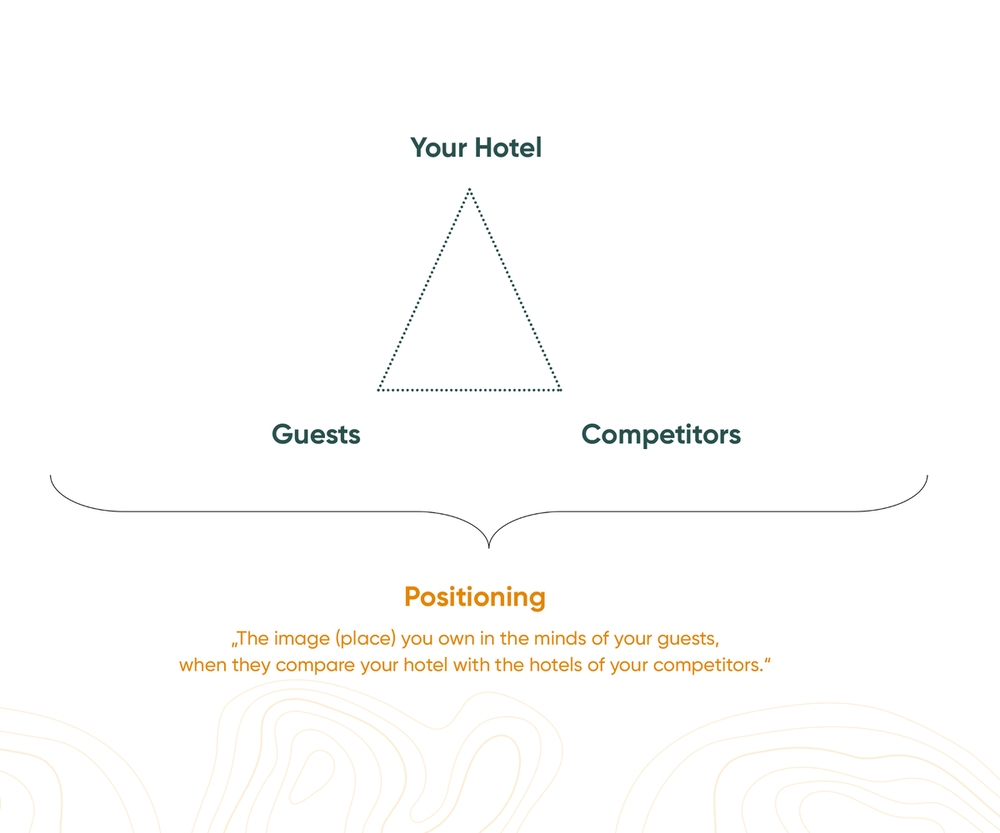
Our hotel clients always get excited about this hotel positioning exercise. But, there is a small “downer” you should know: even if we strive to achieve a clear and unique hotel positioning, ultimately it is not us who decides what the hotel positioning is. The hotel positioning is defined by your People, above all, your guests, and this implies that your control over your hotel positioning is limited.
The importance of strategic hotel positioning for independent hotel businesses

This triangle is called the “Strategic Triangle” that serves to identify long-term business advantages or, as we call it, success potential. Sometimes it is also called the 3C Model, showing the tension field and interplay (therefore we use a triangle) that consists between Customer, Competitor and Company.

And: hotel positioning is the image (place) you own in the minds of your guests, when they compare your hotel with the hotels of your competitors.

If you aren’t different, then you’re in trouble

Now that you understand what hotel positioning is, let’s walk step-by-step in how we at MAp define a hotel’s unique positioning. The fact is, we are experiencing a crowded marketplace. Therefore, we aim to achieve a hotel positioning that:

  • Focuses on relevancy
  • Focuses on differentiation from competition
  • Is credible and attainable
  • Finds a place on the MAp where you / your services are the only answer for a specific someone Now as the last sentence implies, to create your unique hotel positioning you MUST DEFINE for WHOM you are working / WHO this specific someone is.

Only if you have your defined buyer personas ready (= your target guests) you can answer an important question: How do you find your unique position on the MAp? Therefore, if you haven’t defined your buyer personas yet – now’s the time to do it!

Even if we strive to achieve a clear and unique hotel positioning,
ultimately it is not us who decides what the hotel positioning is – it’s the guest.
@weareMAp

Finding your unique position on the MAp

Next, you have to know on which MAp to position your hotel. When working with clients, we like to use a simple and effective positioning matrix. For the purposes of this blog post, let’s keep it simple, and that means you should decide if your MAp is i.e. boutique luxury hotels, family hotels, boutique city hotels, etc.

Once you have defined in which segment to position your hotel, most often you’ll realise that you’re not the first to do so! Even if you’re tapping into a growing market and seeking to serve your specific audience better than your competitors, our MAp advice is to keep digging and to add a further niche into the mix. And, of course, to strive to add something new and exciting to the segment and the hospitality landscape at large. 

How to create a positioning statement

Once you’ve defined your position on the MAp, it’s time to put it down in words. You can do so by crafting a hotel positioning statement. We’ll give you MAp’s positioning statement as an example.

MAp Boutique Consultancy

TO… Innovative investors and boutique hoteliers that need direction, empowerment and support in getting their ventures off the ground, levelling up and setting a strong foundation for growth

MAp IS… the leader in developing and empowering sustainable and innovative hotels and brands

THAT… makes hotels matter by creating a better future for People and Planet.

What’s yours?

TO… __________________________ (target audience / buyer personas) ________(your hotel) IS… __________________________ (your position on the map) THAT… __________________________ (what you will do for your target audience / buyer personas)

And another blog post comes to an end. Maybe we can summarise what we’ve learned today about hotel positioning best with a quote from Simon Sinek:

“In order to stand out, we have to know what we stand for.”

We hope that after our time together, what YOU stand for is much clearer. And if not, please do not hesitate to contact us in order to find your unique hotel positioning on the MAp.


Hotelmarketing

We market your innovative and sustainable hotel

Through our hotel marketing services, we position your independent and boutique hotel on the global MAp – in a unique, sustainable and authentic way.

Blog Block Image
The importance of strategic hotel positioning for independent hotel businesses MAp Boutique Consultancy

Add new comment

Comment

Order

Plain text

  • No HTML tags allowed.
  • Lines and paragraphs break automatically.
  • Web page addresses and email addresses turn into links automatically.
sharing is caring

In the ever-evolving hospitality industry, staying ahead of the competition and meeting the dynamic demands of travellers is paramount. One effective strategy that can breathe new life into a hotel's identity and boost its appeal is undergoing a hotel rebrand. But why is rebranding your hotel important, when should you consider it, and how does it work?

In this blog post, we’ll address these questions and provide you with a clear roadMAp for action, outlining five concrete steps to successfully rebrand your hotel. These steps will empower you to navigate the transformation process and make sure that your establishment remains a highly-desired choice for your guests.

Untertitel
When, why and how to successfully reinvent your hotel image
Blog main image
Hotel-Rebranding MAp Boutique Consultancy
Paragraphs

WHAT is a hotel brand?

First, let’s start with some basics: WHAT is a hotel brand? The answer to this question might seem obvious, but all too often as a hotel boutique consultancy, we realise at the beginning of a hotel branding or hotel rebranding process that it is misunderstood. Therefore, let’s start this blog post with a short definition of what a hotel brand is and what it is not:

A hotel brand is NOT only the hotel logo or the hotel visual design. A hotel brand encompasses a whole set of elements from the visual identity (i. e. your hotel logo, the type fonts you have chosen, the uniforms your employees are wearing), to the visual identity (i. e. your hotel name, slogan, tone of voice) to sensory branding (i. e. how your hotel smells and sounds). In addition to these tangible elements, it includes intangible ones too, like your hotel’s vision, mission and values, which make up your hotel brand’s foundation.

In other words, your hotel brand is the way your hotel products and services are perceived, and therefore, hotel branding encompasses every action your business takes that creates a unique identity in the minds of your potential audience and other People (such as team members, partners, the local population).

Altogether, your brand is a reason to choose your hotel over a competing hotel. That’s why at MAp we like to quote Steve Forbes: “Your brand is the single most important investment you can make in your business.”

WHEN to consider Hotel Rebranding

It’s essential to understand when and in which situations rebranding your hotel might be the right choice for you. Over the last decade working as a creative hotel agency, we have identified the following top 5 indicators that it might be time to reinvent your hotel brand:

1. Market Trends and Shifting Demands:

It's vital to keep a keen eye on market trends and shifting guest demands. Recognising new preferences and emerging opportunities in your target market can signal the need for rebranding of your hotel. Pay attention to guest feedback and reviews, as they often provide valuable insights into the need for change. Over the last years, one of the biggest market trends and shift in demands we have seen is “Sustainability”. Therefore, at MAp we are not only creating stylish and unique brands, but sustainable ones too. You can learn more about sustainable hotel branding in this blog post.

2. Hotel Life Cycle:

Consider where your hotel stands in its life cycle. Because rebranding can be a strategic move, moving your property i. e. from a new establishment to an established one. Or doing a rebranding can be a strategic choice when a hotel undergoes a change in ownership or management, it's often an opportune time to rebrand to reflect the new direction, vision and strategy of the hotel. The same goes for property renovations or expansion.

3. Declining Occupancy and Revenue:

If your hotel is consistently experiencing a decrease in occupancy rates and revenue, or a deluge of bad reviews, it may be time to rebrand to attract a different customer segment or revitalise your image. However, as a hotel creative agency that develops innovative and sustainable hotel concepts, we emphasise that when talking about declining occupancy and revenue the issue often lies deeper. If you are not clearly positioned in the market or do not have a distinctive hotel concept, a rebranding might not help you in the long-run without the strategic groundwork being done as well.

4. Outdated Brand Image:

If your visual identity and elements, such as logo or interior décor, no longer align with the target market's expectations or the current design trends, it may be time for a hotel rebrand to create a more contemporary and appealing image. Also, here it is important to check on the other brand elements and evaluate if they need a refresh too.

5. Market Competition:

Increased competition in your destination or segment may require you to rebrand to stand out and differentiate your hotel from others, showcasing unique features or experiences. This is also always a good time to check on your hotel positioning and hotel concept.

WHY Rebrand Your Hotel

So, why should you consider rebranding? The answer lies in the potential benefits.

  • To make sure that competition is not drowning you out: Rebranding can give your hotel a competitive edge. Not rebranding can leave you falling behind in a highly-dynamic industry.
  • To align with a new vision: Ensure that your branding aligns with your hotel's evolving vision. Case studies of successful rebranding efforts can serve as inspiration.
  • To reach your desired customers: If you're not attracting your desired customer demographic, it might be time for a rebrand. Understand how rebranding can directly impact the guest experience and how improved amenities and services can create lasting impressions.
  • To ensure boosting Profit: Rebranding isn't just about aesthetics; it's about the bottom line. Data shows that successful rebranding is likely to lead to increased Profit as well.

HOW: 5 Steps to Rebrand Your Hotel

Now that we've explored WHEN and WHY rebranding your hotel is essential, let's dive into the HOW - to ensure your transformation is not just an idea, but an effectively-implemented reality.

1. Evaluate your hotel concept and your hotel positioning:

As we say at MAp Boutique Consultancy, first the concept, then comes the rest. This means that you must be very clear about your strategic definition, your hotel positioning in the market, etc. Only then you can derive from it a hotel brand (or can conduct a hotel rebranding) that is sustainable and delivers long-term success.

2. Approach your rebranding holistically and collaborate with a creative agency or hotel consultancy:

Visual Identity and Design: Beautiful things make people happy. Therefore, in this area you can redefine a new or refresh your existing logo, colour schemes, type fonts, etc. Verbal Identity: Does your hotel brand “sound” like every other? Is your slogan strong or weak? Have you identified keywords and statements to repeat in your communications? Is it time to define your unique tone of voice? Sensory Branding: How does your hotel smell and feel? Does it reflect your hotel brand and is it curated? We have created a series of blog articles that gives you further insights on how your hotel can win at sensory branding.

When you recognise that your hotel needs a change or a refresh,
it's not an admission of fault but the first step towards enhanced success.
@weareMAp

3. Think toward the hotel rebrand implementation early on:

As you know by now, at MAp we create sustainable brands. This means that right at the start of a hotel rebranding process, we think about HOW to create a hotel brand that is flexible and can be implemented in a sustainable way = using resources in the most efficient way.

4. Communicate your hotel rebrand internally before you communicate it externally:

Ensure that your staff is well informed to align with the new brand identity. Explain why the hotel rebrand was necessary and how the new brand supports the strategic objectives of your hotel. Also make sure that relevant team members know how they must use and implement the new hotel brand.

5. Launch your new hotel brand the right way:

Use your hotel rebrand to make a big splash. Create an emotional story about the why and the what = what you are expressing with your new hotel brand, what you stand for (your Purpose) and for whom you are the best choice. Engage with both current and potential guests through various channels to generate anticipation. Find important insights about Storytelling HERE.

And then?

Once we launch a new hotel brand in the market, we continuously gather feedback and measure the success of the hotel’s rebranding efforts. This gives us important insights on how we can further optimise the hotel branding, and of course, the success of the hotel business.

Rebranding a hotel is a pivotal decision that should be approached with careful consideration and meticulous planning. A well-executed hotel rebranding effort can breathe new life into a property, attract a broader and more loyal customer base, and rejuvenate a hotel's financial performance. On the other hand, a mismanaged rebranding can lead to confusion, alienate existing customers, and result in significant financial losses. Therefore, getting rebranding right is of paramount importance.

Hotel Branding

Make your hotel matter

If your business is the body, your brand is the soul. MAp Boutique Consultancy crafts sustainable hotel and hospitality brands that are purpose-driven and sustainable, rooted in beauty and authenticity. That’s how we make your brand matter.

Blog Block Image
Hotel-Rebranding MAp Boutique Consultancy

Add new comment

Comment

Order

Plain text

  • No HTML tags allowed.
  • Lines and paragraphs break automatically.
  • Web page addresses and email addresses turn into links automatically.
sharing is caring

 MAp Boutique Consultancy shows you how to craft your unique hotel sustainability story and introduces you to the 10 Principles of Sustainable Communication.

Types
Topic TopCat
Weight
0
sharing is caring

🎧 Prefer listening to reading? Listen to the article here. ▶️


Every two months we explore an important sustainability topic with our MAp community. With boutique and independent hoteliers, investors, consultants, students and other players in the hospitality industry in mind, we make our bi-monthly The Sustainable Hotel Insights as actionable and practical as possible. If you would like to receive these insights straight into your inbox and join the community, aka join us on the journey to a more purposeful and hospitable Planet, register here!

Untertitel
How communication becomes a mindset – and why it matters for sustainable hotels.
Blog main image
Insights: Was ist nachhaltige Kommunikation?
Paragraphs

About: Sustainable Communication

Sustainable communication is how you communicate: specific, respectful, and mindful of impact. Sustainability communication is what you communicate: your goals, actions, and progress. Hotels need both. This guide explains the difference, the core principles, and the wording that helps you avoid greenwashing.

Sustainable Communication is about
HOW you communicate.

Facts: Did you know

Greenwashing continues to stain the hospitality industry, with hotels making claims that are bigger than reality, and consumers are understandably distrusting as a result. Let’s look at these findings by The Sustainable Agency (2023) that show the perils of greenwashing and the risks of getting your sustainability communication wrong:

  • 42% of online sustainability claims were found to be “exaggerated, false or deceptive” in a high-profile study by the European Union.
  • 88% of consumers don’t immediately trust a brand that claims to be sustainable, showing the importance of walking and talking sustainability.
  • 30% of millennials will unfollow accounts that believe to be posting inauthentic content.
  • 90% of millennials – one of the demographics most invested in sustainable living – say authenticity is a top influence when deciding to buy.
  • 40% of people wouldn’t recommend a product to their friends and family if they felt a brand was falling short on its environmental claims.
  • 17% of people would actively discourage their friends and family from buying a product if they felt environmental claims were overstated.
  • 55% of people are looking for companies to explain the sustainability credentials of their product compared to alternatives – simply labelling your product ‘sustainable’ is no longer enough.
  • Companies who mislead online (including greenwashing) could face a fine equal to 10% of annual turnover under proposed legislation in the UK. More laws are likely to follow on questionable environmental claims made online.

Action: Our MAdvice on Sustainable Communication

To practice Sustainable Communication, it’s important to ensure your communication reflect the following:

1. TRANSPARENCY:
Promoting honesty, openness, and trust in your sustainability initiatives.

2. INCLUSIVENESS:
Promoting equality by supporting People of all backgrounds and avoiding discriminatory practices.

3. CULTURAL SENSITIVITY:
Prioritising understanding and respect of local cultures and traditions.

4. CLARITY:
Fostering engagement and building understanding among audience members.

5. RESPONSIBILITY:
Taking responsibility for your actions and avoiding harmful communication practices.

6. AUTHENTICITY:
Making your sustainability journey heartfelt and personal.

7. PROGRESS:
Continually improving your communication practices.

8. RELEVANCE:
Explaining how new sustainable products and services impact your stakeholders.

9. INSPIRATIONAL:
Keeping communications positive and inspiring.

10. ETHICAL:
Ensuring that you never Profit from difficult situations People might be in.

Free Template

Write your hotel sustainability story in three simple steps

A guided three-step template for clear, specific wording with space to add your evidence. Includes the Ten Principles of Sustainable Communication.

Video URL
Blog Block Image
MAp Boutique Consultancy Insights: What is Sustainable Communication?

Add new comment

Comment

Order

Plain text

  • No HTML tags allowed.
  • Lines and paragraphs break automatically.
  • Web page addresses and email addresses turn into links automatically.
Youtube stream image
Insights: What Is Sustainable Communication?
sharing is caring

Today’s most successful and impactful hotel brands are those that have made Purpose their motivating raison d’être. In this blog post, we make the case for why your hotel brand should be driven by a Purpose, and how you uncover it and put it to work for the benefit of your hotel and business, for people and planet.

Categories
Types
Topic TopCat
Weight
0