


sharing is caring
Untertitel
How to WOW your hotel guests via all five senses
Blog main image
Sensory Branding
Paragraphs

See it, smell it, taste it, hear it, feel it. Not only is sensory branding one of our key areas of expertise, it’s something that truly makes our hearts beat faster. 

So why should you care? In times of growing competition, functionally interchangeable hotel products and ever more demanding guests, hotel brands must deliver and wow all five senses. It’s no longer enough to appeal to just one or two. Your guests need to experience your hotel brand on every single level. 

That’s why we are focusing our attention and upcoming series of blog posts to multisensory branding. We will share with you are key insights and tangible actions on how you can successfully master the five senses of your valued guests. So, let’s kick this off. In this first blog post we will introduce you to sensory branding and give you an overview of the different senses and their importance. 

The story so far

To date, the communication of hotel brands has mainly happened on a visual level. For most hoteliers developing the visual identity (logo, corporate identity, imagery, etc.) has been put on a level with developing the entire brand. Only a few hoteliers have gone a step further and included acoustic brand aspects to their brand. E.g. by developing a matching sound signature for their website or background music for the hotel itself (lobby, restaurant, bar, spa etc.). Multisensory approaches, in which hotels deliberately address more than two senses with their brand, are a true exception. 

We believe that the guest perception of a hotel/hotel brand is already taking place on a multisensory level. And, as such sensory branding measures are an ideal branding tool for hoteliers. It also has been scientifically proven that brands that address more than two senses are more successful than those that focus on one or two senses only. So are you missing a trick? Top tourism brands have benefited from this knowledge for decades already and created multisensory and emotional brand experiences. A great example is the successful olfactory (smell) branding of Singapore Airlines which has been implemented since the late 1990s: their custom-made scent is emitted in the cabin, worn by the flight attendants as body fragrance and passengers’ hot towels are scented with the unique smell. 

It also has been scientifically proven that brands that address more than two senses are more successful
than those that focus on one or two senses only.
via @weareMApeople


What the future holds

Martin Lindstrom, author of “Brand Sense: Sensory secrets behind the stuff we buy”, believes that those companies which address as many as possible senses, deliver THE ultimate brand message. This means, that by taking into account the guests’ taste, smell, tactile, visual and auditory senses, strong memories and emotional bonds can be created. These multisensory experiences add to an enriching brand experience, increase the quality and the perceived intensity of the guest experience and ultimately transform the hotel from an interchangeable product to a truly unique experience.

We are convinced that in response to increasing competition, more and more innovative hoteliers will focus on multisensory brand management. Why? Because with sensory brand measures they will achieve better perception and lasting impression by their guests and create stand out in the highly competitive market. Guests on the other hand will increasingly search for hotel brands that are truly perceptible as well as impressive and will remain loyal to them.

“You never get a second chance to make a first impression!”

The sense of sight is the strongest human sense. More than 80% of the information we consume every day is consumed through our eyes. Therefore, the visual first impression of a hotel brand is the one that influences the guest perception most. The visual identity is an integral part of a hotel brand and consists of all visible brand elements: logo (word/design mark), font, colour and imagery, design language (buildings, architecture), symbols, signage, uniforms, etc. With the congruent use of all visible elements you can enhance your hotel brand emotionally and optimise your brand communication short and long-term.

“What is essential is invisible to the eye.”
Antoine de Saint-Exupéry

The influence of the sense of smell is often underestimated. In fact, smell is the sense that has the strongest impact on our memory. Which means that targeted and coordinated addressing of the sense of smell offers an enormous potential to transmit strong brand messages. Fragrances have a great influence on the emotional state of guests and their decision-making behaviour. Many hotels already use signature scents to create a unique and consistent guest experience and brand awareness. The Armani Hotel in Dubai and the Fullerton Bay Hotel in Singapore are great examples of how guests can be touched emotionally via a signature scent. Indigo Hotels take it one step further and change their signature to reflect the season. 

“Funny how a melody sounds like a memory.”
Eric Church

Music, tones and sounds evoke emotions. Targeted sound elements create unforgettable experiences and long-lasting memories for guests. This means that with professional sound design, the brand message can be further enhanced to create an emotional bond with guests.

“Joy has a texture.”
Oprah Winfrey

In the hotel industry, the sense of touch is often underestimated or ignored, even though it plays an important role in the overall guest experience and understanding of the products and its messages. In product marketing for example, haptic features are widely used to build an emotional relationship between the product and the buyer. Via the sense of touch consumers can identify e.g. luxury products. By examining their weight and their condition they are able to unconsciously assess the quality of the product. Textures, fabrics and materials (their weight, softness, etc.) used in a hotel provide a unique opportunity to convey a sense of comfort to the guest.

 “Smell and taste are in fact but a single composite sense, whose laboratory is the mouth and its chimney the nose…”
Jean-Antheleme Brillat-Savarin

The gustatory brand management deals with all experienceable brand elements that can be perceived by the sense of taste. The relevance of the sense of taste is low in comparison to the other senses, as only one percent of our perception is absorbed through the tongue. However, never underestimate the gustatory appeal in the hospitality industry. Various studies indicate that we often eat with our nose, which is another way of saying that if food passes the smell test it will most likely pass the taste test. Especially with food and beverage the sense of smell and taste is essential and thus makes it an important part of the hotel brand experience

Finally, our MAdvice to hoteliers

We want you to open up your world and invite your guests to experience your hotel brand in ways you’ve never considered. These are the ways that will connect with your guest on a deeper level. Ultimately the foundation for successful multisensory branding is a strong and well-defined hotel concept, based on brand identity and characteristics and, consequently, sensory experiences. Sensory branding measures have to be targeted and consciously orchestrated, meaning the right signals have to be sent to the right guest via the right channels. Only the consistent and coordinated addressing of all sensually perceptible points of contact along the guest journey creates a sense of wellbeing and an emotional reaction by the guest. 

We promise, if done right, your guests will become fans of your hotel and love to come back again and again ;-)

As always, we look forward to hearing from you. Feel free to comment below as well as to share this blog post.

Blog Block Image
Sensory Branding

Add new comment

Comment

Order

Plain text

  • No HTML tags allowed.
  • Lines and paragraphs break automatically.
  • Web page addresses and email addresses turn into links automatically.
Types
sharing is caring
Untertitel
How to WOW your hotel guests via all five senses
Blog main image
Visual Branding
Paragraphs

Here’s the second installment of our popular series of blog posts dedicated to multisensory branding for hotels. Time to open your eyes and pay attention as we take you into the world of visual branding. In today’s highly competitive hospitality market a hotel brand needs to appeal and engage all senses in order to be distinct and successful. To sum it up, your guests need to literally see, hear, feel, taste and smell your hotel brand. 

There’s no doubt that vision is the most powerful of our five senses. This makes sense when you consider that around 83% of the information we retain is received visually. However, recent studies reveal that this might only be the case because we are bombarded 24 hours a day with huge quantities of visual information and a lack of other options. There is an opportunity here for all of us, as currently our other senses are not being targeted properly.

How about your hotel brand? Is your hotel visual identity aligned to your distinctive brand message? With our five MAdvices, we invite you to think beyond your own hotel logo and emotionally enhance your hotel brand with the congruent use of all visible elements. 

Your guests need to literally see, hear, feel, taste and smell
your hotel brand. 
via @weareMApeople


Our five MAdvices to win with a holistic visual brand management for hotels

“The question is not what you look at, but what you see.”
Henry David Thoreau 

1 – Logo: The logo is the symbol of the entire hotel brand, it's the corporate identity packed in a single sign. As a cornerstone of the visual identity it must of course reflect and embody your stylistic ideas, but above all emotionally touch the defined buyer personas. To find the perfect logo for your hotel brand we recommend taking a closer look at the logos of competitors as well as best practice examples (logos of companies you like and might not even be related to hospitality), in order to not only differentiate the logo from them, but also learn from them.

Take a look at the logo we crafted for our client paloria: based on the cool residence concept for athletes and sporty connoisseurs, the logo takes inspiration from contemporary sport and lifestyle brands. Not only does it emotionally speak to the defined buyer personas, but it also expresses the vision of our cool and stylish clients.

2 – ​Imagery: “A picture is worth a thousand words.” So make it count! Invest the time and resources needed to create and use distinctive key images/visuals that are clearly connected with your hotel brand. High quality photos are an absolute must for every hotelier to persuade the guest to regularly visit its website or social media feeds. Wait, what about videos? They are getting more and more important on social media and in general as they are a brilliant way to craft your visual branding. An emotionally charged and high-quality hotel video helps your guests to understand your product or service best. 

A creative way of establishing a truly distinctive visual language for a hotel you can see with the Kandima Maldives illustration. Be brave and stand out from the crowd and opt for illustrations (or other creative tools) that can help you to build a strong and distinctive visual language.

3 – ​Design language: Distinctive design generates distinctive brands, and successful brands are by their very nature visually “smashable”. If you are planning to design a new hotel, then we invite you to consider how your building can become unique in its form, architecture, style and design. The Marina Bay Sands in Singapore or the Burj al Arab in Dubai show the power of unmistakable design in the hotel industry. The sail-shaped design and its exposed location of the Burj al Arab make the building is unmistakable. Or think at our loved Baros Maldives - the overwater fine dining restaurant, The Lighthouse, is so unique in its structure that it is unmistakably connected to this resort. And of course, is featured on most of its key visuals. 

Besides considering the uniqueness of your architecture we also suggest to select a recurring form within your hotel, such as those used in the furniture or design. If you want your hotel to be perceived as sympathetic, friendly and modern, then square forms make an excellent visual shape choice for communication materials (square business cards, brochure, writing pad, etc.). Why is it important to select a brand shape? Shape is an instantly recognisable visual aspect of any brand. Statistics show that e.g. 40% of all perfume purchase decisions are based on the design of the bottle.

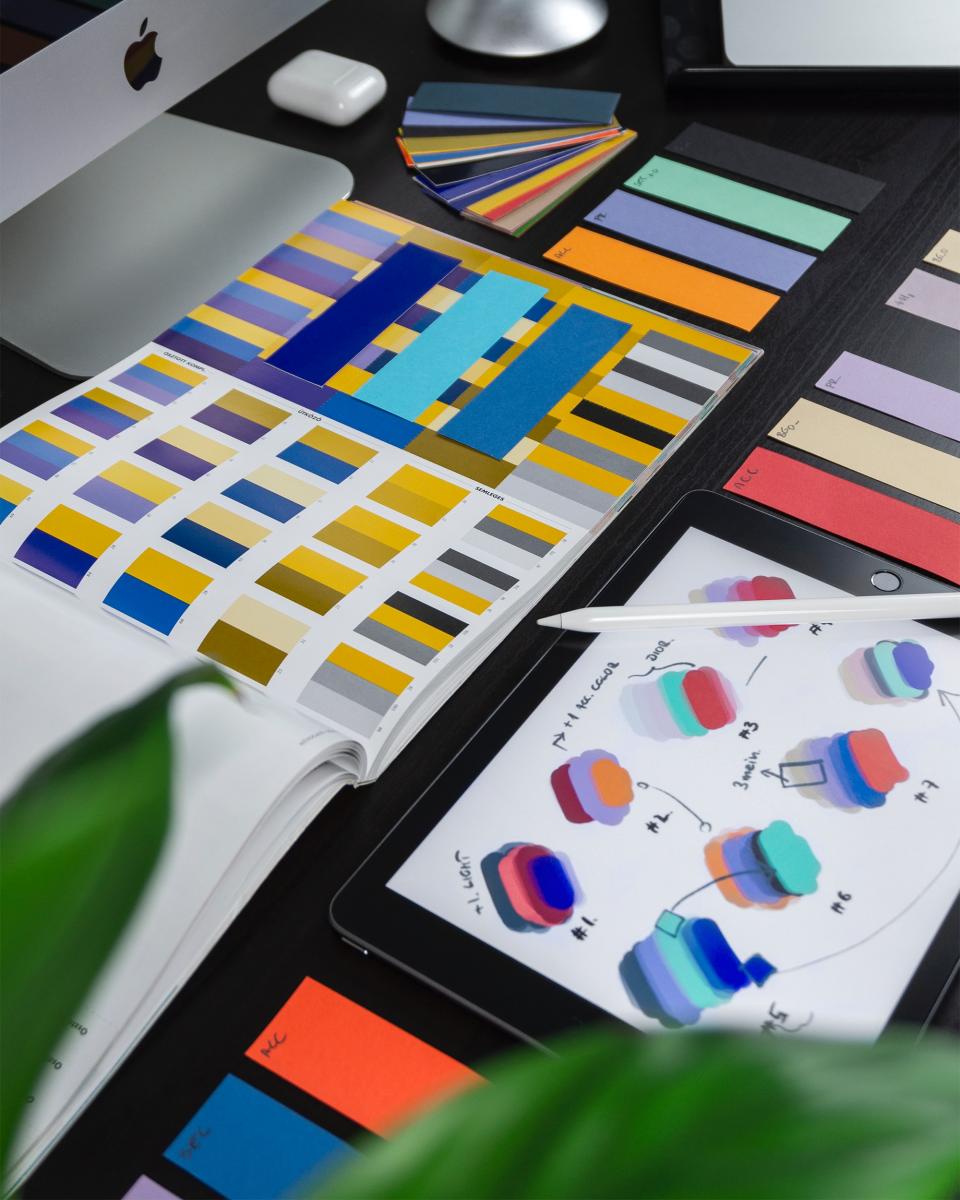
4 – ​Colour: Define your colour/s and use them consistently in your communication and throughout your website and social media channels. In addition to pictures, colour has the highest recognition value and thus can be used as exclusive brand mark. We all know that there is also a psychological association to each colour, that e.g. green stands for eco-friendly and freshness, blue conveys trust and purple is often associated with creativity and luxury. A little off topic, but Viagra – Pfizer has successfully taken advantage of the visual component and has given their pill not only a distinctive blue colour but also a unique diamond shape!

How can you decide on what colours you need for your hotel brand? It’s simple really. Just base it on your hotel concept and positioning. A brand such as Kandima Maldives might use a wide and playful colour palette, while Haritha Villas + Spa gives space to its contemporary architecture and lush surroundings and works with white and black as their main “colours” with green colour accents reflecting its natural location.

5 – ​Font: Fonts matter - and not just to graphic designers! All your defined signature fonts are seen by your guests (hopefully) everywhere: on your website, communication materials, etc. Therefore, the font you choose for your hotel is a valuable tool to express your brand personality and to evoke additional associations and emotions. Distinctive typography helps you to enhance your hotel brand character and conveys your tone. Have e.g. a look at the website of citizenM and the one of Edition Hotels: both of the brands have chosen a font perfectly matching their brand personality. Just imagine how strange it would look if you would switch the fonts between the two websites. Remember, guests learn a lot about your hotel brand based on the font you choose. 

Consistency is key. Apply the same distinctive imagery, the same colour, the same design language, the same font type across your visual platforms - at all times. It creates cohesion, so that your guests always get the same story across all channels.

As always, we look forward to hearing from you. Feel free to comment below as well as to share this blog post.

Thank you and all the best for WOW-ing your guests via your distinctive visual identity,
Your MA people

Blog Block Image
Visual Branding

Add new comment

Comment

Order

Plain text

  • No HTML tags allowed.
  • Lines and paragraphs break automatically.
  • Web page addresses and email addresses turn into links automatically.
Types